Ad plures ire
Über literarische Antizipation nach Walter Benjamin (Wien: Passagen 2022)
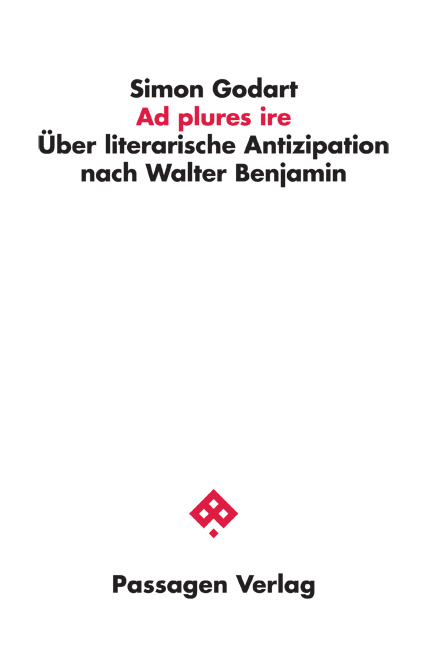
That literature still reaches us over centuries is not solely our achievement. Our current reception corresponds with a past anticipation that is inscribed in the texts. Literary communication takes place between times and creates a collective, it speaks to a „we“ that it must anticipate and yet can only expect.
“ ‚Ad plures ire‘ meant to die for the Latins,“ Walter Benjamin reminds us and gives euphemism an unforeseen afterlife. Going to the many no longer sugarcoats death, but becomes a symbol of aesthetic and philological experience. These many form a collective of the deceased, who still address us through writing, speak to us, and await us. The essays gathered here attempt to follow this collective through Ovid, Montaigne, Lacan, and finally Benjamin, and describe its persistence. Reception corresponds with literary anticipation, the impossible yet necessary anticipation of the many future readings that every text brings with it.
Passagen
Zitat und skeptische Poetik bei Michel de Montaigne und Pierre Baylee (Padeborn: Fink 2021)
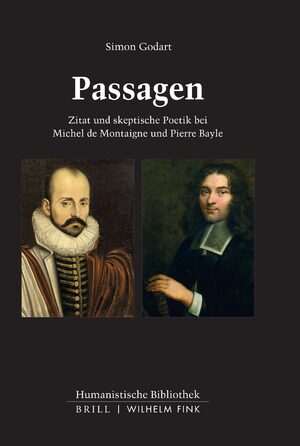
How does the use of the words of others in quotation relate to thinking and to the form of skeptical discourse in the French Late Renaissance and Early Enlightenment?
Montaigne’s emprunts from humanistic scholarship are a central component of the poetics of his Essais; his characteristic peinture de passage orchestrates a shift of voices within his large humanistic self-portrait. Citation – avant la lettre, since Montaigne did not yet have the concept and convention – becomes a formal means of skeptical writing that seeks to keep things in suspension. Pierre Bayle takes up this technique in his „Dictionnaire historique et critique“ to reshape it with the means of bibliographic precision; now conventionalised in quotation marks and footnotes, quoting becomes the critical modus operandi of a skeptical shaking of the historical foundations of the philosophical tradition.
Bildbruch. Beobachtungen an Metaphern (Berlin / Basel, since 2020)

Bildbruch is an online journal that appears several times a year. Founded by me and Sina Dell’Anno in 2020, it is devoted to the ‚observations on metaphors‘ in philosophy, philology, and literature, endebted to the concept of metaphorology after Hans Blumenberg. In focussing on catachrese / „Bildbruch“ rather than metaphoricity, our journal is interested in the linguistic conditioning of thinking and knowledge, which is exemplified wherever catachrestic moments arise: in semantic frictions between two intertwined images or between expression, figurative transposition and meaning. Bildbruch sees itself as an open forum for the observation and processing of metaphors and metaphorical complexes and their literary, historical, and systematic functions – especially at moments when they relate to their pictorial nature, when their figuration becomes fragile, and where the use of transfer capabilities results in a poetic or poetological, rhetorical, and intellectual-historical surplus. The metaphors that are thus brought into focus are catachreses in a double sense: they are at the same time „necessary and original“ and „abusive and excessive“ transfers, both upstream and downstream of the systems of rhetoric and philosophy – and it is precisely in this bipolarity that their explosive potential lies.
Articles, Edited Volumes and Special Issues
- Hrsg., zusammen mit Anne Eusterschulte: Frühe Neuzeiten. Bildbruch 7 (2025).
- Darin: „Erkenntnis oder der Weg dorthin Descartes’ Methodenbegriff“, S. 68–94.
- „Siculus Mare. Times, Tides and Tragedies“, in: Baltic Peripeties. The Power of Narration and the Making of Regions, hrsg. Eckhard Schumacher und Cordelia Heß, Göttingen: Brill | V&R unipress 2025, S. 41–62.
- „Halbe Ewigkeiten„, in: Bildfäden. Kleine Formen. Berlin: Schlaufen Verlag 2025.
- Hrsg., zusammen mit Beatrice Gründler und Johannes Stephan: Framing Narratives, Living Handbook of Temporal Communities 2024. (peer-reviewed).
- Darin: “Mundus est Fabula”, 2024.
- „Getting Closer. Approaching Rhetoric From a (Certain) Distance“, in: Blumenberg’s rhetoric, hrsg. D. S. Mayfield, Boston: De Gruyter 2023, S. 153–175.
- „Zeichen und Wunder. Bayles Komet und Kants Geschichtszeichen“, lointain. Zeitschrift für Philosophie 3 (2022), S. 21–34.
- Hrsg. (gemeinsam mit Andreas Strasser):„Utopie und Idylle„, Bildbruch 4 (2022).
- Darin: „Utopie und Idylle. Einige Beobachtungen an zwei Metaphern/Katachresen“, S. 14–35.
- „Rückschritte, Irrwege. W. Benjamin, lecteur de C. G. Jochmann„, Recherches germaniques, 51 (2021), S. 121–135.
- „The Poet as Speculator. Reading Baudelaire’s Economic Subjects with Benjamin“, in Writing the Economic Subject in Modern Western Europe, hrsg. Aileen Behrendt und Nicholas Courtman, Berlin: Peter Lang 2021, S. 85–112.
- „,Totum relucet in omnibus‘ Zum Verhältnis von negativer Anthropologie und negativer Theologie in Sonnemanns Cusanus-Lektüre“, in: „Denn das Wahre ist das Ganze nicht…“ Beiträge zur Negativen Anthropologie Ulrich Sonnemanns, hrsg. Tobias Heinze & Martin Mettin (Promesse – Kritische Studien zu Philosophie, Ästhetik, Geschichte und Religion, Bd. 6), Berlin: neofelis 2021, S. 345-368.
- „Alte Namen, neue Mythen. Remythisierung und Präfiguration bei Hans Blumenberg„, Bildbruch 2 (2021), 172–196.
- „Gewalt und Entzug“ & „Schwierige Geburten“, in: Ovid-Handbuch. Leben – Werk – Wirkung, hrsg. Melanie Möller, Stuttgart: Metzler 2021, S. 359-364 & S. 388-391.
- „Heiterkeit. Anekdotische Isosthenie bei Montaigne“, in: Wissen en miniature. Theorie und Epistemologie der Anekdote, hrsg. Matthias Grandl und Melanie Möller, Wiesbaden: Harrassowitz 2021, S. 107–130.
- Hrsg. (gemeinsam mit Sina Dell’Anno):„Weltenphilologien„, Bildbruch 1 (2020).
- Darin: „Die Auslegbarkeit der Welt und die Hermeneutik der Faktizität“, S. 64–81.
- „Grotesque Poetics. Michel de Montaigne’s Use of Grotesques in De l’Amitié (I 28)“, in: Between Allegory and Natural Philosophy. New Perspectives on Renaissance Grotesques, hrsg. Damiano Acciarino, CRRS Essays & Studies, Toronto 2019, S. 219–240.
- „Lovecraft. Seltsame Sprachlosigkeiten“, in: Enter – Ausstellungskatalog, (=Toupet 1) Berlin 2014, S. 14–17.
- Hrsg.: Perspektiven nach der Postmoderne – Conference Proceedings, Paideia 2 (2014).
- Darin: „Den alten Namen erwähnen – Derridas Foucault-Kritik als Perspektive für die Geschichtsphilosophie“, S. 105–115.